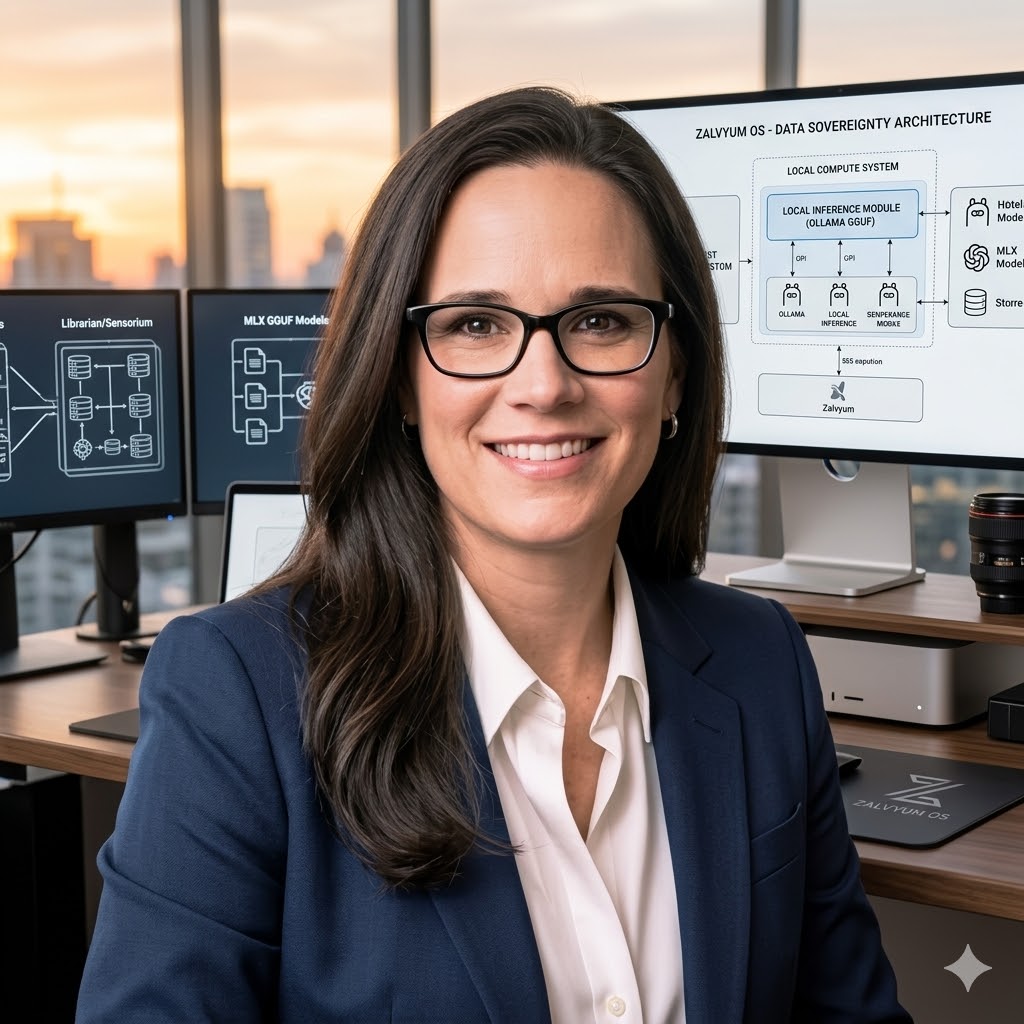
Built by people who lived the problem.
Zalvyum wasn’t designed in a vacuum. It emerged from two specific frustrations: one with autonomous AI that burns money silently, and one with enterprise systems that capture data but don’t help you decide. We built it because we needed it.
The current AI paradigm is a dependency trap. The industry sold us the illusion that advanced compute must live in the cloud, forcing us to rent our own cognition, send confidential data to third-party corporations, and tolerate the lack of control. The promise was delegate and forget; the reality for the business sector has been runaway costs, hallucinations, and an unacceptable structural vulnerability.
I decided to build something completely different. As a Systems Architect, I refused to accept an ecosystem where you don’t own your infrastructure.
That’s how Zalvyum OS was born. It’s not an interface or a middleman; it’s an Agentic Operating System designed from the ground up for total data sovereignty. I built a local-first environment, with real persistent memory and an inference engine surgically optimized for the Apple Silicon ecosystem. I designed the architecture so that local 16GB hardware operates with the force and potential of a larger cloud model, but without its weaknesses.
Here, the human directs and the machine executes within a hardened perimeter. Zero external dependencies. Zero information leaks. Your data never leaves your hard drive unless you command it.
That’s where we’re headed: toward true technological independence and the decentralization of cognitive power. My goal is for every user and company to be the absolute owner of their digital nervous system.
I’m the technical founder. I build the core, compile the architecture, and set the system rules at the kernel level to guarantee that power and privacy remain exactly where they belong: in your hands.
As an operator, I don’t see companies by departments. I see them as systems. Thirty years building, stabilizing, and scaling multi-unit retail networks, distribution centers, and large-scale operations across Mexico, LATAM, and China taught me that. P&L up to $360M MXN annually, ~25% sustained growth, 6+ countries and 40+ cities operated on the floor — Sam’s Club, H-E-B, Soriana, GNC, OfficeMax, Gantong in China, Key Química.
Here is what three decades on the store floor and in the franchisee boardroom taught me: most commercial problems aren’t commercial. They’re design failures — misalignments between demand, operations, and supply, disguised as low sales, turnover, or poor execution. The MBA from UMass Amherst gave me the vocabulary. The warehouse gave me the truth.
I don’t theorize about operations. I’ve fixed them. Shrinkage from 25% to 5% with inventory accuracy at 97%. 150 stores led across 9 states. A franchise network grown ~25% annually, sustained. A China operation taken from zero to $5M USD in three years — a 5x. Best regional performance and lowest national turnover at Soriana. Every one of those numbers came from redesigning a system, not pushing harder on a broken one.
I’m interested in how systems behave under pressure. That’s where it shows whether they’re well designed — or whether they depend on people to hold together. I don’t build structures for when everything goes fine. I build systems that keep running when conditions change. One principle governs all of it: if it’s not replicable, it’s not growth.
When Erika described Zalvyum, I recognized it immediately: the same systemic architecture I’d applied to retail for thirty years, now applied to cognitive infrastructure. Most ERPs treat a business as departments. That’s why operators end up making real decisions on opinion when they should be making them on data. Zymbio Business is what happens when an engineer who builds the system and an operator who lived the pain build the same product.
I’m your audit lead and operational point. I diagnose your operation as a system, design your Zymbio configuration around how your business actually runs, and stay with you through your first quarter as a Founding Member. Strategy means nothing without operational execution. That’s the part I own.
Why two co-founders for a software company.
Most software companies have technical founders. Some have commercial founders. Few have both as founders, especially in early stage.
We made that choice deliberately because Zymbio isn’t a software product. It’s an operational intelligence system that requires deep technical execution AND deep operational expertise to deploy correctly.
Erika builds it. Walther deploys it.
Together we know what your business needs because one of us is the engineer who made it possible, and the other is the operator who needed it for thirty years.
That’s the team. Two pains, one product, hands-on for every Founding Member.
The team reads every application personally.
Founding Members get hands-on onboarding with both of us. Erika configures and installs. Walther runs the operational audit and designs your Zymbio.